AI data extraction that turns documents and voice into fields you can check.

We build AI pipelines that read financial statements, contracts and voice notes and return structured fields, each editable and traceable to where it came from. Four are in production: credit assessment, contract due diligence, jobsite reporting and family task capture. Each shipped as a fixed-scope sprint.

Free call · Fixed-scope quote within 48h

Build sheetAI data extraction
Inputs
PDF financial statements, contracts and agreements, scanned documents, and voice notes up to 30 seconds, in more than one language.
Outputs
Fields against a fixed schema, with a confidence score or source reference, editable on a review screen, then saved to your database or synced to the tools you already use.
Stack
Structured outputsOpenAIWhisperGPT-4o-miniPostgresSupabase
Timeline
2 to 3 weeks for an extraction pipeline with a review screen inside an existing workflow. Longer inside a new product.
Price
Fixed scope, fixed price, quoted within 48 hours of the scoping call.

Four extraction pipelines in production.

Different inputs, same pattern: a fixed schema, a review step, then ordinary code.

Financial statements into figures

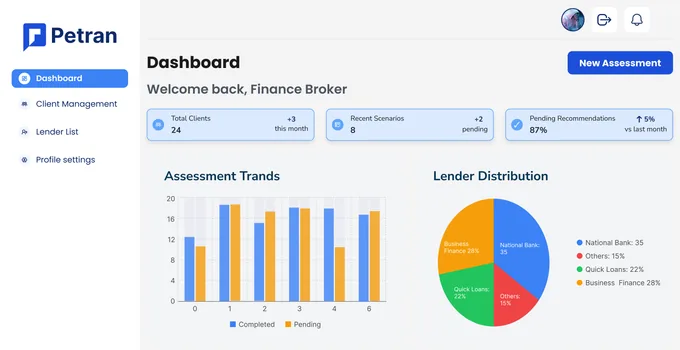
A broker drops in a P&L. The model returns trading income, operating profit, depreciation, interest and non-trading income, each with a confidence score and editable. Code then calculates DSCR. About 90 minutes of manual review became under ten.

See it in Petran
Contracts into risk flags and key terms

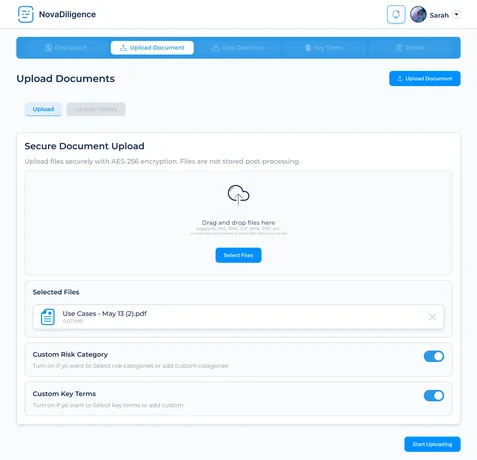
Encrypted contracts are swept across 20 risk categories. Each flag carries a severity, the document and page, and the surrounding clause. Payment terms, IP assignment and liability clauses are lined up across every contract in the deal.

See it in Nova Diligence

Jobsite voice notes into daily reports

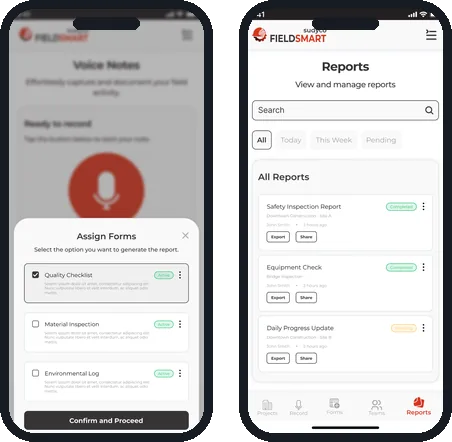
A foreman holds to record. Whisper, tuned for construction vocabulary, transcribes the note, then a structured-output prompt fills the right form across 25+ templates, flags RFIs and files it against the project.

See it in Field Smart

Spoken reminders into structured tasks

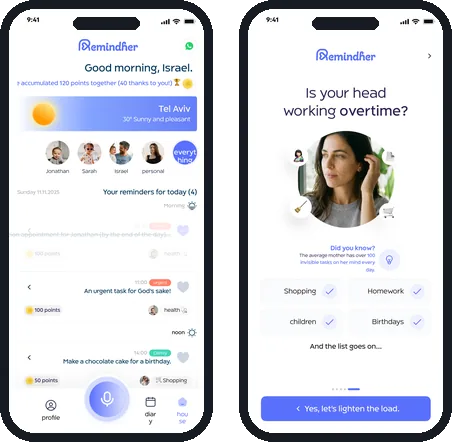
“Remind me to…” becomes a task in about four seconds. Whisper transcribes, GPT-4o-mini returns five fields, a calendar conflict check runs in the same call, and the user sees every parsed field before saving.

See it in RemindHer
Schema first

Decide the fields before you write a prompt.

AI data extraction means using a language model to read unstructured input, such as a PDF, a contract or a voice note, and return specific fields in a fixed format. The important word is fixed. We define the schema first: every field, its type, and what happens when it is missing. The model fills that schema through structured outputs instead of writing free text.

Keep reading

A fixed schema is what lets the next step be ordinary code. In Petran the five extracted figures feed a DSCR calculation; in Field Smart the fields map to one of 25+ report templates. Nothing downstream has to parse prose.

Traceable output

Every field should show where it came from.

An extracted value nobody can verify is a liability. In Nova Diligence every risk flag carries its severity, the exact document and page, and the clause text around it, so a reviewer can check it without opening the original PDF.

Keep reading

In Petran each figure carries a confidence score, which tells the broker where to look first. Traceability is what turns AI output from something people second-guess into something they can sign off.

Human review

The model drafts. A person confirms.

Every pipeline we have shipped ends in a review screen, not a silent write to the database. Petran’s broker can edit any figure. Field Smart’s foreman scans the generated form before filing. RemindHer shows what it heard, what it parsed and what it is about to save.

Keep reading

Review is fast because the model has already done the reading. The person’s job shrinks from typing everything to checking a few highlighted values.

Voice input

A voice note is a document too.

Speech is often the fastest way to capture information where typing is impractical: on a jobsite with gloves on, or with a child on one arm. The pipeline is the same: transcribe with Whisper, then extract fields against a schema.

Keep reading

Two details matter in practice. Vocabulary tuning, so trade terms and brand names transcribe correctly. And language handling, since both Field Smart and RemindHer are built for users who switch languages mid-sentence.

Five steps, no month-three surprise.

Fixed scope, a demo every Friday, and a first clickable version around day 7. The full process is on the home page.

  1. Day 0 Scoping call Thirty minutes to map the product and pick the stack. Fixed quote within 48 hours.
  2. Week 1 Wireframes to a clickable version Screens, flows and the data model. On day 7 you click, not read.
  3. Weeks 2 to 3 Core flows, demoed every Friday Built and integrated in the open. You test on the real build.
  4. Week 4 QA, deploy, handoff Deployed to production with handoff docs and a recorded walkthrough.
  5. Ongoing Sprints as usage teaches you A retainer or feature sprints, monitored, async over Slack and Loom.

The Data Extraction Sprint

For teams re-keying information from documents or voice into a system by hand, inside an existing product or a new one.

2 to 3 wks
  • A fixed extraction schema agreed on the scoping call
  • Extraction pipeline with confidence scores or source references
  • A review screen where every field can be checked and corrected
  • Save to your database or sync to the tools you already use
  • Evaluation set built from your real documents
  • Handoff docs, cost monitoring and a recorded walkthrough

Add-onsVoice input · multi-language · custom categories and terms · PDF reports · monthly tuning retainer

Fixed scope · Fixed price
Demo every Friday

Scope it in one call

Asked before every ai data extraction build.

Everything else gets answered on the scoping call.

Ask us directly

Using a language model to read unstructured input, such as PDFs, contracts, scanned documents or voice notes, and return specific fields in a fixed format. The output is structured data your systems can use, not a written summary.

Financial statements, contracts, scanned documents and voice recordings are all in production on products we have built. If a person can read the information off the page and type it into a form, a pipeline can usually extract it.

The model fills a fixed schema rather than writing freely, each field carries a confidence score or a source reference, and a person reviews the result before it is saved. Calculations and decisions then run in ordinary code.

Yes. Field Smart and RemindHer transcribe speech with Whisper, then extract fields against a schema. Both handle users who switch languages mid-sentence, and Field Smart is tuned for construction vocabulary.

Wherever the work continues: your own database, a calculation such as Petran’s DSCR engine, a report, or an external platform. Field Smart syncs filed reports to construction platforms such as Procore.

Two to three weeks for an extraction pipeline with a review screen inside an existing workflow. It is a fixed-scope, fixed-price sprint, quoted within 48 hours of the scoping call.

Re-keying documents by hand? Let us scope the pipeline.

Bring two or three sample documents or recordings. In 30 minutes we agree the fields, the review step and where the data should go, and you have a fixed-scope quote within 48 hours.