 RaftWorks
Applicant tracking on one rubric
A four-stage job wizard, interview questions drafted per competency and approved by the hiring manager, and stage-gated scorecards so every candidate is scored on the same questions.
See it in Project ATSApplicant tracking, onboarding, field workforce operations and team analytics, built permissions-first with SSO and the integrations that decide adoption. Week three is how we measure the build, not launch day.
Free call · Fixed-scope quote within 48h
Three shipped products, each a daily driver for the team that asked for it.
A four-stage job wizard, interview questions drafted per competency and approved by the hiring manager, and stage-gated scorecards so every candidate is scored on the same questions.
See it in Project ATSHold to record on the jobsite. AI fills the daily report with crew, hours, activity and RFIs across 25+ templates and syncs to eight construction platforms. Offline-first.
See it in Field SmartFour roles with their own data scope: admins reconcile, managers see attainment by rep, reps see their pipeline, clients see only theirs. It replaced a Friday spreadsheet.
See it in XDRhubWorkflows that match your org chart, including what happens when it changes, with digest notifications in Slack or Teams and CSV in and out.
Every one documented end to end: the problem, the build, the result. Filter the case studies.
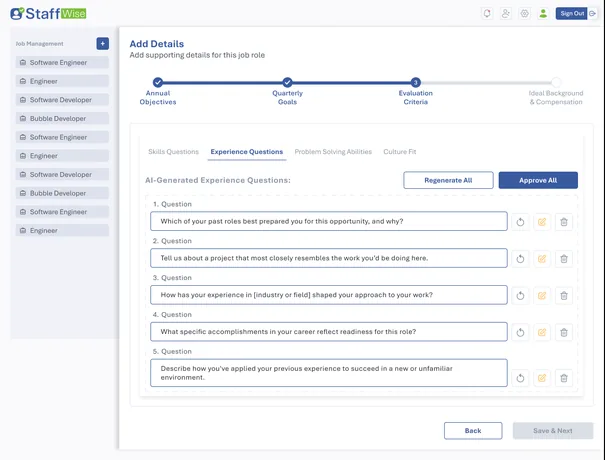
An internal ATS that turns hiring from a spreadsheet juggling act into a structured pipeline, a 4-stage job-creation wizard, AI-generated interview questions per competency, and…
Read the case study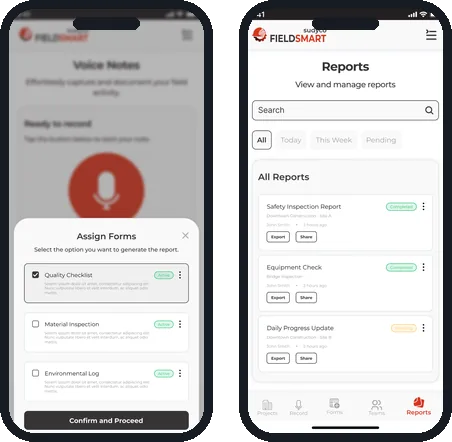
A mobile-first construction documentation platform, voice-to-form for the jobsite, multi-language ready, with AI extraction of crew, time, activity, and RFIs, then per-project filing and…
Read the case study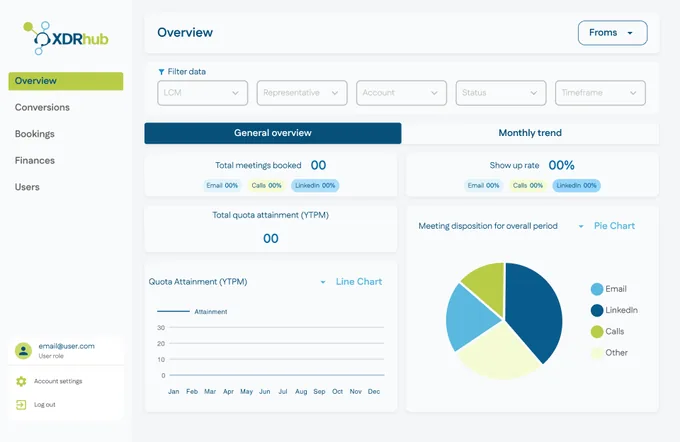
A four-role analytics platform that replaced a Friday-afternoon Google Sheet. Apollo.io syncs prospects in. Admins reconcile bookings against client disputes. Account managers see…
Read the case studyInternal tools do not fail at launch. They fail quietly three weeks later when the spreadsheet comes back. So we design the adoption mechanics in from day one: single sign-on so there is no password wall, notifications where people already work (Slack or Teams, with digest controls so nobody drowns), and workflows that match the actual org chart rather than an ideal one.
Project ATS is the pattern. Every open role goes through the wizard, every candidate is scored against the same rubric, and every interview round is gated by a completed scorecard. It became the daily driver because it removed steps, not because it added a dashboard.
HR data has layers. A support admin should never see salaries by default. A manager sees their reports, not their peers’. A client of an agency sees their own numbers and nothing else. We start every HR build with the four-role matrix (employee, manager, HR, admin, or the equivalent for your organisation) and put compensation and performance data behind separate permissions from the directory.
XDRhub runs four roles across nine screens with a five-state booking record and an audit trail on every change, which is what made disputes between the agency and its clients a lookup instead of an argument.
Field Smart replaced paper daily reports with a hold-to-record button. Transcription is tuned for construction-domain terminology and accented speech across several languages, and AI extracts crew, hours, activity and RFIs into structured forms filed per project. It is offline-first with deferred sync, so a form captured in a basement is preserved until the truck reaches signal.
The same pattern applies to onboarding paperwork, incident reports and reviews: capture in the medium people already use, structure it with AI, keep a human in the approval step.
HRIS and payroll integrations go wrong when two systems both think they own a field. We map which system stays the source of record for each one, then sync one direction per field: native APIs where they exist, scheduled imports where they do not. SSO comes first, because every extra login screen costs adoption.
Field Smart ships with eight direct API integrations into construction management platforms. Project ATS lives inside the company’s own domain. XDRhub keeps Apollo.io as the source of truth and acts as the referee.
Fixed scope, a demo every Friday, and a first clickable version around day 7. The full process is on the home page.
For HR teams and founders replacing spreadsheets with real tooling: ATS, onboarding, reviews, field workforce operations.
3 to 5 wksAdd-onsPerformance cycles · anonymous surveys · payroll and HRIS sync · voice capture
Fixed scope · Fixed price
Demo every Friday
HR tools live or die on two things: whether the permissions model matches how the organisation actually works, and whether anyone opens the tool in week three. This checklist covers both: data model, integrations, and the adoption mechanics most builds skip.
Everything else gets answered on the scoping call.
That is usually the point. We map which system stays the source of record for each field, then sync one direction per field, via native APIs where they exist or scheduled imports where they do not. SSO comes first, because every extra login screen costs adoption.
Compensation and performance data live behind separate permissions from directory data; a support admin never sees salaries by default. Every sensitive action lands in an audit log, and export and erasure flows are built in from the start for GDPR-style requests.
Three things we design in from day one: SSO so there is no password wall, notifications where people already work with digest controls, and workflows that match your org chart, including what happens when it changes. We measure success at week three, not launch day.
It can draft them. In Project ATS the model generates questions per competency for a role, and the hiring manager approves or regenerates before anything reaches a candidate. Every candidate for that role is then scored on the same approved set, which is what makes the comparison fair.
Yes. Field Smart is a mobile-first app for construction crews: voice capture, offline-first, multi-language, synced to the platforms the office already uses. Frontline tools need bigger targets, fewer screens and no dependency on signal, and we design for that.
Fixed scope, fixed price, quoted within 48 hours of the scoping call. Price is driven by the number of roles in the permissions matrix, the integrations in scope and whether AI features are included, not by hours.
Bring the workflow, rough is fine. In 30 minutes we map the tool, the roles and the integrations, and you have a fixed-scope quote within 48 hours.