 RaftWorks
Credit decisioning and lender matching
Upload a P&L, extract the figures with an LLM, calculate DSCR and rank 13 lenders deterministically. A broker assessment went from about 90 minutes to about 10.
See it in PetranLending engines, bookkeeping portals, payment flows and market dashboards, shipped in weeks with the compliance conversation on day one. We ride on licensed rails, keep card data out of scope and reconcile every cent.
Free call · Fixed-scope quote within 48h
Each one is a product we have shipped, not a slide.
Upload a P&L, extract the figures with an LLM, calculate DSCR and rank 13 lenders deterministically. A broker assessment went from about 90 minutes to about 10.
See it in PetranLive QuickBooks reports, a document vault, Stripe-billed subscriptions and a support desk, bound through one ledger with a fifteen-minute sync.
See it in TrupennyForty-plus live metrics across six asset classes, a market-regime read and a twice-daily AI summary, for about $100 a month instead of a terminal seat.
See it in MacroPulseA timed 130-question team assessment scored across six dynamics, with tiered reports and token billing, inside a startup investment platform.
See it in Team DNAEvery one documented end to end: the problem, the build, the result. Filter the case studies.
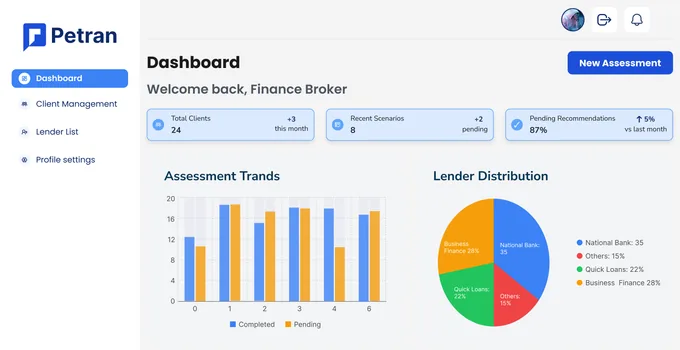
An AI-assisted finance broker platform. Upload a client's statements, extract the numbers with an LLM, calculate DSCR, and match the scenario against a live rate-card of lenders, all…
Read the case study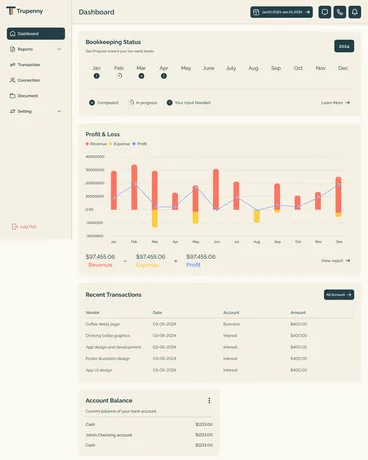
A done-for-you bookkeeping firm needed a client portal that didn't feel like a 1995 web form. We built one, QuickBooks-synced reports, secure document vault, Stripe-billed subscriptions…
Read the case study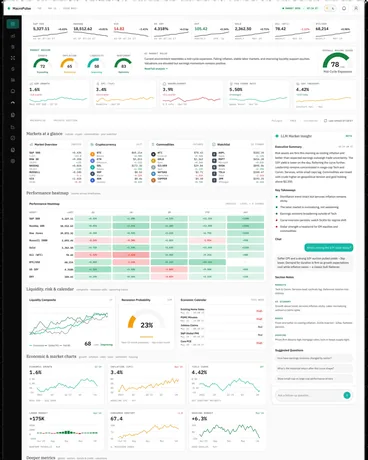
A Koyfin-class personal markets dashboard. Forty-plus live metrics across stocks, crypto, commodities, macro, credit, and housing on one surface, with a market-regime read, per-ticker…
Read the case study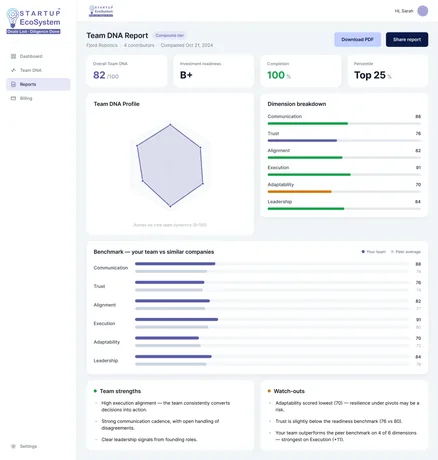
A team-assessment feature for a startup investment platform. Founders invite their team to a timed, ~130-question assessment; the platform scores six core team dynamics and generates…
Read the case studyThe regulated activity in a lending marketplace, a payments product or an investment tool is usually carried by a partner that already holds the licence: Stripe or Stripe Connect for moving money, Plaid for account data, a banking-as-a-service provider for accounts and cards, the lenders themselves for the credit. Your product orchestrates those rails, holds the relationship and the data model, and stays out of the regulated perimeter.
We map which model fits on the first call. If the idea genuinely needs its own licensing path, we say so before anything is built, because that is a lawyer conversation and it is cheaper to have it in week zero than in week six.
Finance products fail quietly: a refund lands in a different place from the charge, a payout is netted before it is recorded, a dispute is settled on a phone call and never written down. We build an append-only transaction ledger from the first sprint. Corrections are new entries, not edits, and a reconciliation view compares the ledger to the processor every day.
Before launch we run the boring tests that catch expensive mistakes: penny transactions end to end, refunds and partial refunds, webhook replay, a payout with fees netted, a dispute opened and closed. Trupenny shipped with every receipt linked to a transaction and every report partner-letter ready, because the ledger was designed before the screens were.
The temptation in 2026 is to hand the whole decision to a language model. We do not. In Petran the LLM does one job: read a client’s statements and extract the figures into a structured schema the broker can see and correct. DSCR, the loan scenario and the lender ranking are ordinary code, so the shortlist is explainable, repeatable and defensible to a client or a regulator.
That split, extraction by AI, decisions by rules, is how we approach every finance workflow that touches an approval: fast where speed helps, auditable where it counts. Thirteen lenders’ spreadsheets and PDFs became structured rule sets, and the output is a ranked, explainable shortlist exportable as a client-ready document.
Products that carry money, encryption requirements or heavy calculation are written as code: a React or Next.js front end, a Postgres database, Stripe and QuickBooks through their official APIs, with agentic tooling doing the repetitive work and senior developers owning the architecture and reviewing every change. Where a product is small and template-shaped, a low-code platform can be quicker and we will say so.
You keep the repository, the database and every integration account. Handoff includes documentation, a recorded walkthrough and the runbook for the reconciliation job, so the product is yours to run or to hand to the next team.
Fixed scope, a demo every Friday, and a first clickable version around day 7. The full process is on the home page.
For teams shipping a product that moves, manages or reports on money: marketplaces, client portals, lending workflows, finance ops tools.
4 to 6 wksAdd-onsMulti-currency · invoicing · dispute workflows · accounting sync
Fixed scope · Fixed price
Demo every Friday
The 30 checks we run before any product that moves money goes live: compliance scoping, payments architecture, security, and the launch-day QA that catches the expensive mistakes. Two pages, zero fluff.
Everything else gets answered on the scoping call.
Usually not, if the architecture is right. Most MVPs ride on licensed rails: Stripe, Plaid or a banking-as-a-service partner carries the regulated activity, and processor-native KYC covers onboarding. We scope which model fits on the first call, and flag early if your idea genuinely needs its own licensing path. That is a lawyer conversation, and better had before building.
We keep card data out of your stack entirely. Hosted checkout or tokenised fields mean the serious PCI burden stays with the processor. Your product stores tokens and ledger entries, never raw card numbers.
Through the official APIs: Plaid for bank accounts and transactions, QuickBooks for the books, Stripe for billing. Trupenny binds all four through one ledger with a fifteen-minute sync and a visible timestamp, so a dashboard is never silently stale.
For reading documents, yes, with a human able to correct every extracted figure. For the decision itself we use ordinary, deterministic code so the result is explainable and repeatable. Petran works exactly this way: the model extracts, the rules decide, the broker sees why.
Australian equipment finance (Petran), UK marketplaces with held deposits (Aptavo), North American bookkeeping and investment tooling. Payment rails and tax rules differ by country; the ledger, reconciliation and audit architecture does not.
Fixed scope, fixed price. The scoping call maps the product, the compliance posture and the stack, and you have a written quote within 48 hours. Price is driven by the number of integrations, the roles in the portal and whether payouts or lending logic are in scope, not by hours.
Bring the idea, rough is fine. In 30 minutes we map the product, the compliance posture and the stack, and you have a fixed-scope quote within 48 hours.