RaftWorks
Leads from anywhere
Add a contact from Clearbit for company enrichment, from Apollo.io for prospect lists, or by hand with the eight fields that matter.
See it in StaticWe build simple CRMs for founders and small sales teams who do not need Salesforce: import a lead, drop them into an email sequence, and see every follow-up on the day it is due. It replaces a lead spreadsheet, reused email templates and follow-ups forgotten after day three.
Free call · Fixed-scope quote within 48h
Each feature below is running in production in the case study it links to.
Add a contact from Clearbit for company enrichment, from Apollo.io for prospect lists, or by hand with the eight fields that matter.
See it in StaticBuild a nurture sequence of emails, delays and tasks, and let it run. Each sequence can be active, paused or in draft.
Every follow-up with its due date and priority, as a list for triage or on a weekly calendar you can drag items around.
Meeting scheduled, contract sent, won or lost. Deliberately fixed, so the team closes deals instead of redesigning columns.
The build this page is based on, documented end to end. Browse all case studies.
Big CRMs bring per-seat pricing, weeks of setup and fields nobody fills in. The person running sales in a small business mostly needs three things: their leads in one place, sequences that send themselves, and a list of who to follow up with today.
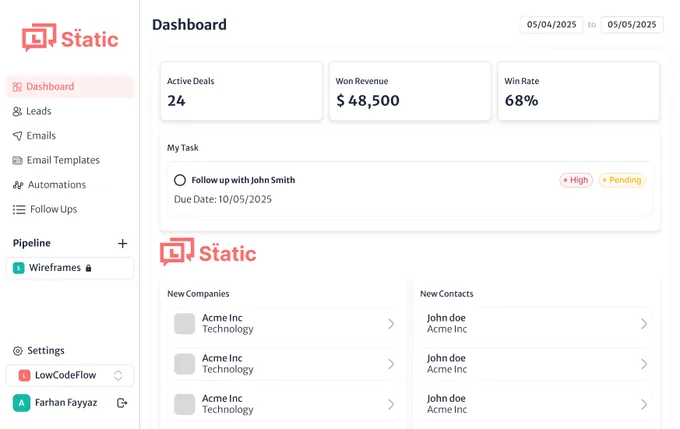
Static was scoped deliberately small around those three jobs, with a dashboard of just three numbers: active deals, won revenue and win rate.
Many CRM rollouts stall while the team designs custom stages. Shipping with four fixed stages keeps the focus on moving deals, and closed stages can be hidden with one toggle when the board gets busy.
Fixed scope, a demo every Friday, and a first clickable version around day 7. The full process is on the home page.
For small and mid-sized businesses replacing email threads and shared spreadsheets with a tool built around how they work.
3 to 4 wksAdd-onsAI features · data migration from your spreadsheets · mobile app · monthly support retainer
Fixed scope · Fixed price
Demo every Friday
Everything else gets answered on the scoping call.
When off-the-shelf CRMs are too heavy or too expensive per seat for how you actually sell, and what you need is a few core jobs done well: leads, sequences and follow-ups.
Yes. Static adds contacts from Clearbit, Apollo.io or manual entry.
Yes. Sequences combine emails, delays and tasks and run on a schedule.
A focused CRM has far fewer moving parts than a large platform. You own the code and avoid per-seat fees; most teams keep a light retainer for changes.
Typically 3 to 4 weeks, as a fixed-scope, fixed-price build quoted within 48 hours of the scoping call.
Bring the spreadsheet or process you want to replace. In 30 minutes we map the tool, recommend a stack and send a fixed-scope quote within 48 hours.