RaftWorks
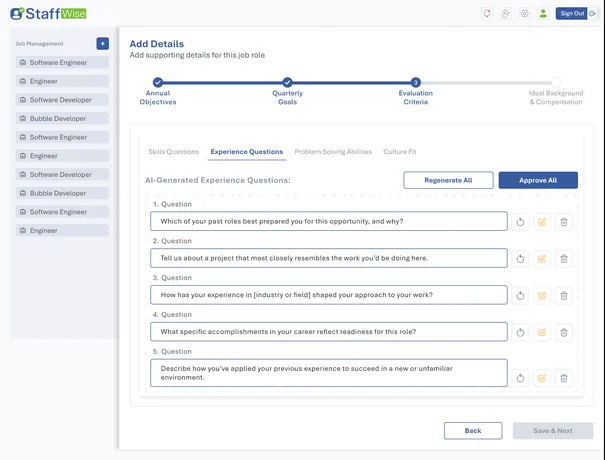
A four-step job wizard
Objectives, quarterly goals, competencies and compensation bands captured once per role, so the evaluation rubric is grounded in the work rather than the title.
See it in Project ATSWe build custom applicant tracking systems for growing teams: define each role once, let AI draft the interview questions per competency, and score every candidate against the same rubric so ranking is a column, not a debate. It replaces hiring run on Google Sheets, scattered interview docs and scorecards lost in Slack.
Free call · Fixed-scope quote within 48h
Each feature below is running in production in the case study it links to.
Objectives, quarterly goals, competencies and compensation bands captured once per role, so the evaluation rubric is grounded in the work rather than the title.
See it in Project ATSRecruiters answer short prompts per competency (skills, experience, problem solving, culture fit) and the model generates the question set in seconds, to approve or regenerate.
A round cannot be marked complete until its scorecard is filled, so candidates never reach the offer stage with half a rubric.
Candidates rank by total score on the same rubric, diverging interviewer scores are flagged, and interviews are scheduled with reminder emails without leaving the tool.
The build this page is based on, documented end to end. Browse all case studies.
When each hiring manager invents their own questions, two candidates for similar roles are judged against entirely different bars, and “who is strongest?” becomes unanswerable once more than two people have opinions.
Generating one question set per role and scoring every candidate against it makes comparison a side effect of the data. In Project ATS the AI drafts the questions; people approve them and do the scoring.
An admin dashboard shows open roles, applications per role, time in each stage and interviewer load, so a role stuck in one stage for weeks, or an interviewer with eight loops, is obvious early.
Fixed scope, a demo every Friday, and a first clickable version around day 7. The full process is on the home page.
For small and mid-sized businesses replacing email threads and shared spreadsheets with a tool built around how they work.
3 to 5 wksAdd-onsAI features · data migration from your spreadsheets · mobile app · monthly support retainer
Fixed scope · Fixed price
Demo every Friday
Everything else gets answered on the scoping call.
A custom ATS fits your exact stages, rubric and roles, and you are not paying per seat for features you never use. It makes most sense when your hiring process is distinctive or you hire steadily.
In Project ATS the model drafts interview questions per competency from short prompts; recruiters approve or regenerate them, and people still do all the scoring.
Yes. Invites and reminder emails are sent from the tool, so there is no separate scheduling handoff.
Yes. Recruiters, hiring managers and admins each have their own permissions.
Typically 3 to 5 weeks, as a fixed-scope, fixed-price build quoted within 48 hours of the scoping call.
Bring the spreadsheet or process you want to replace. In 30 minutes we map the tool, recommend a stack and send a fixed-scope quote within 48 hours.